
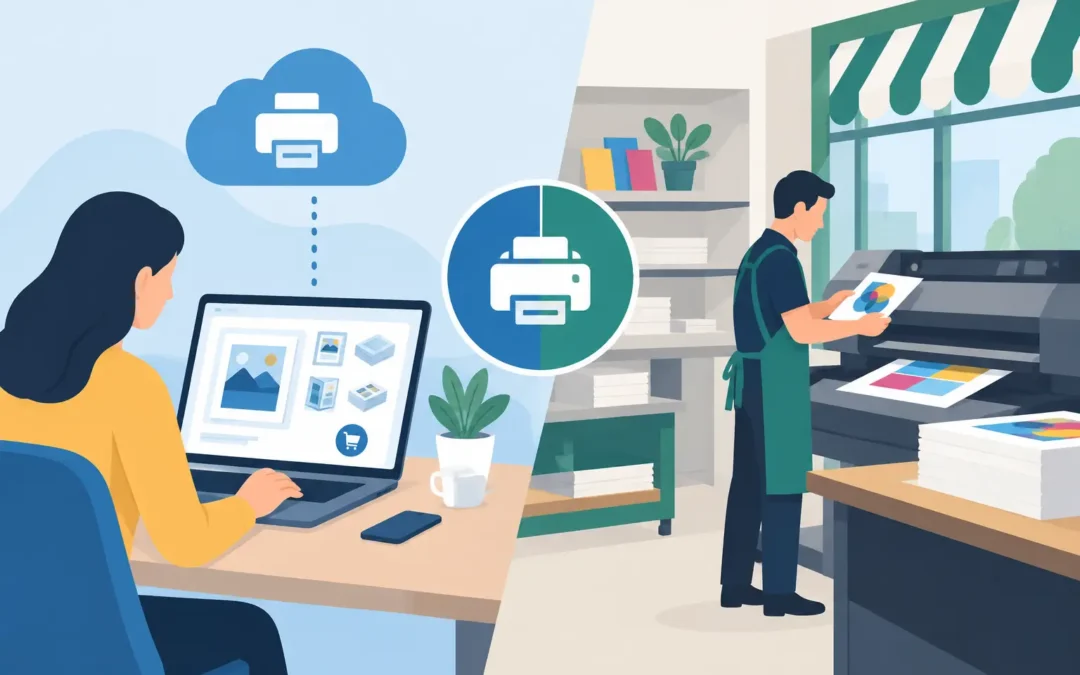
A restaurant needs 500 takeout menus before the weekend. A real estate agent needs an open-house sign by Friday morning. An event planner finds a typo on a sponsor board the day before installation. In each case, online printing versus local printing is not an abstract purchasing decision. It affects whether the materials arrive on time, look right, and help the business make an impression when it matters.
Both options can produce excellent work. The right choice depends on your deadline, the complexity of the job, how much hands-on support you need, and whether you can afford a delivery delay. For everyday standardized orders, online ordering can be efficient and cost-effective. For urgent, high-visibility, or detail-sensitive work, a local production partner can offer control that is difficult to replace.
Online Printing Versus Local Printing: The Core Difference
Online printing is built for convenience at scale. You choose a product, upload artwork, select specifications, approve the order, and wait for shipping or delivery. It works particularly well when the design is final, the product is familiar, and your timeline has room for production and transit.
Local printing puts production closer to your business. You may still order online, but you have access to a real team that can review files, discuss paper stocks, adjust a proof, coordinate a rush job, and arrange pickup. That proximity matters when a printed piece is part of a sales meeting, hotel event, storefront launch, trade show, or property listing with a fixed date.
The comparison is not simply digital versus in-person. A capable local printer can offer online ordering and nationwide shipping, while an online-only provider may offer polished self-service tools. The real distinction is how much direct access you have to the people and equipment producing your order.
When Online Printing Makes Sense
Online printing is often the practical choice for planned, repeatable projects. If your company has approved business card artwork, a finished postcard design, or a standard brochure that has been printed before, online ordering removes unnecessary steps. You can place an order outside normal office hours, reorder from saved files, and compare product options without scheduling a call.
Price can also favor large online print operations, especially on high-volume, standard-specification products. Their production model is designed around batching similar jobs together. If you need thousands of basic flyers several weeks from now and the artwork is press-ready, an online order may give you an attractive per-piece cost.
Online platforms are also useful for distributed teams. A company with employees in multiple states may prefer a centralized ordering system for routine collateral. The key is to confirm that the system uses approved templates, controls logo usage, and prevents outdated materials from being reordered.
Still, convenience depends on the job being straightforward. The minute you need a custom size, unusual finishing, special substrate, color guidance, variable data, or a fast correction, a fully automated checkout path can become a limitation.
Where Local Printing Delivers More Value
Local printing earns its value when time, visibility, and accuracy are on the line. A business owner can speak directly with a production specialist instead of submitting a support ticket and waiting for a response. That can prevent a low-resolution logo, missing bleed, incorrect fold, or color issue from becoming an expensive finished-product problem.
For Miami Beach businesses, pickup can be the deciding factor. Shipping estimates are estimates. Weather, carrier volume, damaged packages, and missed deliveries can disrupt an otherwise well-planned order. Being able to collect brochures, banners, menus, postcards, or presentation folders directly from the printer gives you certainty for time-sensitive work.
Local providers also make it easier to evaluate materials before committing to a larger run. A premium business card does not feel the same on every stock. A window graphic needs to suit the glass, lighting, and installation conditions. A retractable banner needs to be readable from a distance, not just attractive on a computer screen. These are business decisions as much as print decisions.
Hands-on service matters most for projects that combine multiple pieces. Consider a grand opening that requires postcards, door hangers, window graphics, table tents, posters, and exterior signage. Managing each item through separate online vendors may look inexpensive at first, but it adds approval cycles, shipping schedules, and opportunities for inconsistent color. One local partner can coordinate the full package and keep the brand presentation aligned.
Speed Is More Than Turnaround Time
Many buyers compare printers by looking only at stated production days. That misses the full timeline. A two-day print turnaround can still become a five- or six-day project once file review, proof approval, shipping, and delivery are included.
Ask four direct questions before placing the order: When does production begin? When is the final approval deadline? Is the stated date an in-hand date or a ship date? What happens if the file needs correction?
For an urgent job, local production can compress those steps. A qualified order may be produced for same-day pickup, while a design issue can be addressed immediately with in-house support. Sobe Express, for example, serves deadline-driven Miami Beach businesses with fast turnaround, professional design assistance, and same-day in-store pickup for qualifying orders placed by 11 a.m.
That does not mean every job should be rushed. Specialty finishes, large quantities, custom fabrication, and complex sign installations need appropriate production time. The advantage of a local conversation is that you receive a realistic schedule before making promises to your client, team, or event venue.
Quality Control: What You Can and Cannot See Online
A screen cannot reliably show the final look of print. Monitor settings vary, and digital previews do not reveal the weight of a cardstock, the texture of an uncoated sheet, the richness of a soft-touch finish, or the durability of an outdoor sign material.
Online printers can deliver strong quality, particularly when files are properly prepared and the product is standardized. But the burden is often on the buyer to understand trim size, bleed, safe margins, color mode, resolution, folds, and finishing requirements. If your team has print-ready files and experience with those specifications, that may be no problem.
If not, local support can save more than it costs. A knowledgeable printer can flag whether a photo will appear pixelated at poster size, whether small type will disappear against a dark background, or whether a brochure panel needs adjustment so folds land cleanly. That review protects brand credibility before the presses run.
Price: Compare the Full Cost, Not the Checkout Total
Online printing often wins the first price comparison because the product price is visible immediately. But businesses should compare the complete cost of getting usable materials where they need to be. Add shipping, rush fees, reprint risk, design revisions, packaging, and the time your staff spends resolving problems.
Local printing may have a higher unit cost on some commodity products, especially very large runs. Yet it can be the better value when a missed deadline would cost a sales opportunity, an event appearance, or a client relationship. A banner that arrives one day late is not a bargain. Neither are 1,000 flyers with an incorrect phone number.
The most effective approach is to match the supplier to the job. Use planned production cycles for predictable, repeat orders. Reserve responsive local service for launches, events, premium collateral, complex displays, and anything that cannot be delayed.
Choosing the Right Option for Your Next Job
Start with the deadline. If the item must be in your hands by a specific date, work backward from that date and account for proofing, production, shipping, and setup. Next, consider the level of risk. A simple reorder of internal forms has low risk. A trade show backdrop, investor presentation folder, or restaurant menu launch has much higher stakes.
Then consider the degree of customization. Standard cards and flyers are easy to buy online. Custom signage, unusual sizes, multiple coordinated pieces, and products requiring installation benefit from direct guidance. Finally, decide how much support your team needs. Self-service is efficient when you know exactly what to order. Expert help is efficient when you do not.
The best print partner is the one that helps your materials show up polished, accurate, and ready to work. Before your next deadline becomes urgent, keep a trusted printer, approved artwork, and realistic production schedule ready to go.
Recent Comments