
A 5,000-piece postcard campaign, 75 premium business cards, and a same-day event sign should not automatically go on the same press. The offset versus digital printing decision affects your turnaround time, unit cost, color expectations, and the level of customization you can bring to a job. Choose the right method early, and your order moves faster with fewer compromises.
For most business buyers, this is not a technical debate. It is a production decision: What needs to be printed, how many do you need, when do you need it, and what must the finished piece accomplish? Here is how to make that call with confidence.
Offset Versus Digital Printing: The Core Difference
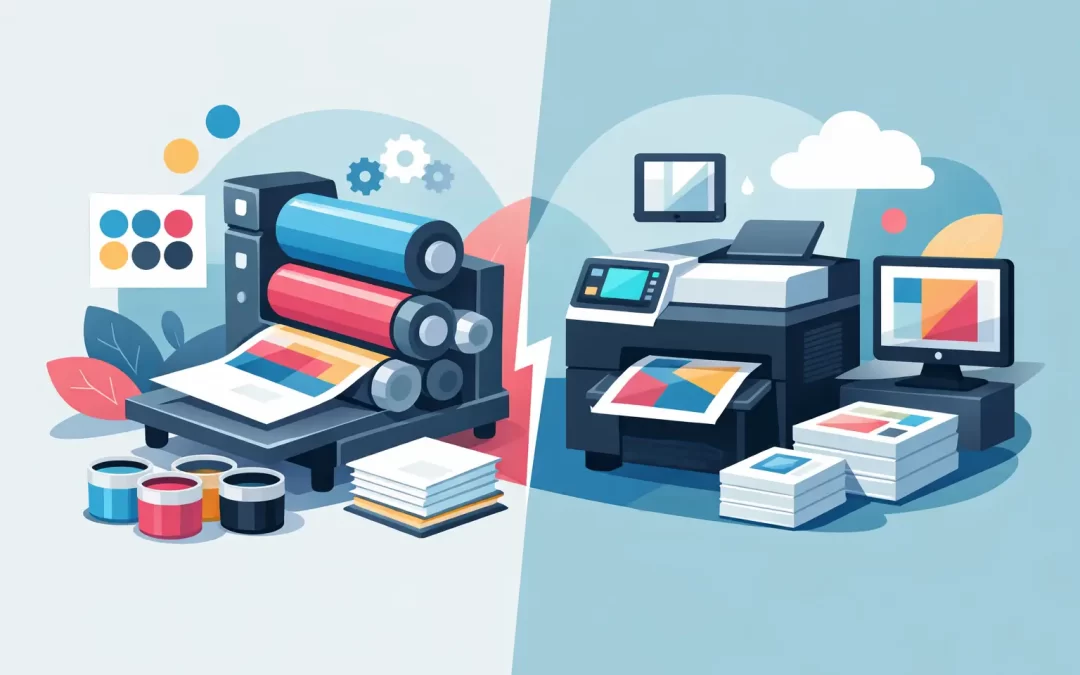
Offset printing transfers ink from metal plates to a rubber blanket, then onto paper or another substrate. The press must be set up for each job, which takes more time upfront. Once it is running, however, it produces large quantities efficiently and with highly consistent results.
Digital printing sends a file directly to the press. There are no printing plates to create, so setup is fast and short runs are far more practical. A digital press can also change information from one piece to the next without stopping production, making it the clear choice for personalized materials.
Neither method is automatically better. Offset is built for volume and demanding color control. Digital is built for speed, flexibility, and practical ordering at smaller quantities.
When Digital Printing Is the Better Business Move
Digital printing is often the right answer when timing is tight. If your restaurant needs table tents for a weekend promotion, your real estate team needs open-house flyers by tomorrow, or an event coordinator needs last-minute handouts, eliminating plate setup matters.
It also makes sense for low- to mid-volume orders. With offset, the setup cost is spread across the full run. On a small order, that setup can push the per-piece cost higher than digital. Digital printing lets you order what you need now instead of overbuying simply to reach a price break.
Customization is another major advantage. Consider a direct-mail campaign with each recipient’s name, neighborhood, offer code, or sales representative printed on the piece. Digital variable-data printing can produce those versions in one run. The same approach works for numbered tickets, personalized invitations, targeted postcards, and employee-specific collateral.
Digital is especially useful for businesses that revise materials frequently. Price sheets, menus, service lists, property flyers, sales one-sheets, and training documents can become outdated quickly. Printing shorter digital runs reduces waste and helps your team keep current information in market.
Digital printing works best for
Digital is a strong fit for quick-turn business cards, short-run brochures, postcards, presentation materials, personalized mailers, and on-demand corporate stationery. It is also ideal when you want to test two offers or creative versions before committing budget to a larger campaign.
That does not mean every digital job is a rush job. It means you have more control. You can order in smaller batches, update files when needed, and keep your marketing moving without waiting for a long production schedule.
When Offset Printing Delivers Better Value
Offset printing earns its place when quantity increases. While it has a higher upfront setup cost, the cost per piece typically drops as the run grows. For a major hospitality promotion, a citywide postcard drop, a large retail rollout, or recurring corporate collateral, those savings can become meaningful.
Offset is also known for exceptional color consistency over long runs. If your brand uses precise signature colors, especially Pantone spot colors, offset gives you more control over the final result. A specific orange, blue, or metallic ink can be mixed and printed as its own color rather than reproduced through standard process inks.
The material range can be broader, too. Offset production is well suited to certain specialty papers, custom ink choices, and high-end print projects where texture, finish, and color accuracy carry as much weight as the message. Think premium catalogs, art books, high-volume brochures, branded stationery programs, and polished direct-mail campaigns.
Offset requires planning. It is not the best fit for a 100-piece order needed this afternoon. But when your quantity is high and your schedule allows for setup and proofing, it can deliver top-quality print at an unbeatable per-piece price.
Offset printing works best for
Offset is usually worth considering for large-volume flyers, postcards, catalogs, booklets, annual reports, multi-location promotional campaigns, and brand-sensitive materials that require spot colors. It is particularly effective when the same design will be used for thousands of pieces and there is little need for personalization.
Compare Cost the Right Way
The biggest pricing mistake is comparing only the total order price. Look at the cost per usable piece, the risk of waste, the value of your deadline, and whether the artwork will need to change.
A 10,000-piece offset run may have a very attractive unit cost. But if your campaign changes after 6,000 pieces are distributed, the remaining inventory becomes a storage problem rather than a savings. For a fast-changing business, a smaller digital order can be the more profitable choice even if each piece costs more.
On the other hand, ordering 500 copies digitally every month may cost more over a year than planning one offset run of 6,000. The best choice depends on how stable your design and messaging are, not just the price shown on the first quote.
Ask four practical questions before deciding:
- How many pieces will we realistically use before the information changes?
- Is the deadline fixed, and how much time is available for production?
- Does each piece need different names, codes, locations, or messages?
- Are exact brand colors or specialty inks essential to the campaign?
Your answers usually point clearly toward digital, offset, or a combination of both.
Color, Quality, and Finishing Expectations
Both methods can produce professional marketing materials. A well-prepared file, the right paper stock, and proper finishing often influence perceived quality as much as the press itself.
Digital color is highly capable for most everyday business applications. Business cards, brochures, flyers, postcards, and sales materials can look sharp, saturated, and polished. For organizations that need close but not exact reproduction of a brand color, digital is often more than sufficient.
Offset provides added control when color matching is non-negotiable. Pantone inks, smooth solid-color areas, and long-run consistency are traditional offset strengths. If your brand standards specify an exact spot color across packaging, campaign materials, or high-visibility collateral, discuss that requirement before choosing a method.
Finishes matter as well. A thick uncoated business card sends a different message than a glossy postcard. Soft-touch lamination, spot UV, foil, folding, scoring, die cutting, and binding can elevate a piece, but not every finish is equally available or economical on every press and quantity. The finished use should guide the specification.
Do Not Treat Large Format as a Simple Offset-or-Digital Choice
Posters, banners, window graphics, foam boards, acrylic signs, and event displays are generally produced with specialized digital equipment rather than a conventional offset press. These pieces are often printed on vinyl, fabric, rigid board, or other display materials that require a different workflow.
For an event, retail opening, property listing, or storefront promotion, the more useful questions are size, viewing distance, installation surface, durability, and deadline. A banner seen from 30 feet away needs a different design approach than a counter sign viewed up close. The print method supports the application, but it should not distract from the job’s real purpose.
How to Prepare Your File for Either Method
A clean production file prevents delays regardless of the press. Use high-resolution images, build artwork at the final trim size, include bleed where needed, and keep important text safely inside the trim area. If your job has folds, cuts, or variable data, call those out before production begins.
Color setup deserves attention. Files intended for commercial print should generally be built in CMYK, while critical branded colors should be identified clearly. RGB images can look bright on a screen but shift when converted for print. A proof is the right time to catch concerns, not after the full order is produced.
If you are unsure about paper, finish, folding, or color expectations, ask before uploading. In-house design support can save time by resolving production details early rather than forcing a rushed correction later.
Choose the Press Around the Result You Need
Need 100 updated brochures for tomorrow’s sales meeting? Digital printing is likely the efficient choice. Planning a 25,000-piece postcard campaign with a fixed design and precise brand color? Offset may offer the better return. Running a personalized outreach campaign? Digital gives you the flexibility offset cannot match in a single run.
Sobe Express helps businesses match each project to the right production path, from fast local collateral to larger campaigns and specialty displays. Bring the quantity, deadline, artwork, and goal to the conversation. The right print method is the one that gets your message into customers’ hands at the quality, speed, and price your business actually needs.
Recent Comments