
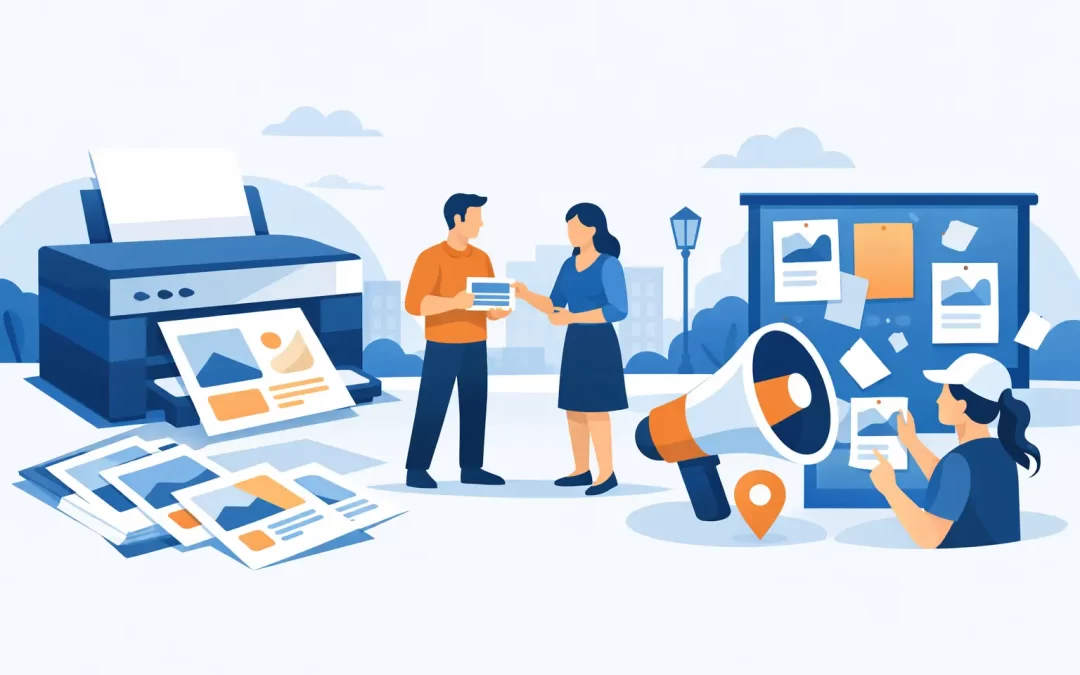
A lunch special is only valuable if people see it before deciding where to eat. An open house needs attention before buyers fill their weekend schedule. A new fitness studio, salon, retail shop, or local service business cannot afford to wait weeks for awareness to build. Flyer printing local promotions gives businesses a direct, physical way to put a timely offer in front of nearby customers.
The difference between a flyer that gets noticed and one that gets discarded is rarely just the paper. It is the offer, the message, the placement, and the speed of execution. When those pieces line up, a simple printed flyer can drive foot traffic, calls, bookings, event attendance, and repeat visits without draining a local marketing budget.
Start With One Local Action
A flyer should not try to explain everything about your business. Its job is to move someone toward one immediate action. That could mean visiting a store, scanning a QR code, reserving a table, calling for an estimate, attending an event, or bringing the flyer in for a limited-time offer.
Choose the action before the design begins. A Miami Beach restaurant promoting weekday happy hour needs a different message than a real estate agent promoting an upcoming open house. A contractor looking for estimate requests needs different information than a retailer clearing seasonal inventory.
Keep the offer specific. “Great service” is a brand claim. “20% off your first facial through Sunday” gives people a reason to act now. Strong local promotions usually combine a clear benefit with a deadline, geographic relevance, or an easy redemption method.
Make the Offer Easy to Understand at a Glance
People often see flyers while walking, waiting in line, checking mail, or moving through a busy event. You have seconds to earn attention. The headline should tell the reader what is happening without forcing them to decode the design.
Lead with the promotion, not the company history. “Grand Opening: Free Coffee This Friday” is stronger than “Welcome to Our New Café.” “Two Weeks of Unlimited Classes for $29” is more compelling than “Join Our Gym.” Your business name, logo, and supporting details still matter, but they should support the offer rather than compete with it.
A practical hierarchy keeps the page working hard. Put the main offer at the top, follow it with the key details, then make the next step obvious. Include the business name, location, phone number, website or QR code, and any terms that affect redemption. If customers need to show the flyer to claim the deal, say so clearly.
Avoid crowding every service, product, social channel, and review into one piece. A flyer is not a brochure. When there is too much copy, the promotion becomes harder to remember.
Use Images That Prove the Experience
A strong photo can sell the atmosphere of a hotel event, the finish of a menu item, the appeal of a retail product, or the before-and-after impact of a service. Generic imagery can work in some cases, but original photos usually build more credibility for local businesses because they show customers what they can actually expect.
For a service business, show the result. For a restaurant, show the dish. For an event, show the venue or featured entertainment. If the photo does not make the offer more believable or desirable, leave it out and let the headline breathe.
Choose Flyer Printing for Local Promotions by Campaign Goal
Size, stock, and finish should match how and where the flyer will be used. A compact handout works well for street teams, trade shows, front-counter distribution, and bag inserts. A larger format gives real estate listings, event schedules, menus, and detailed service offers more room to make an impact.
Standard letter-size flyers are useful when the message includes several details, while smaller formats can feel more immediate and portable. For door-to-door distribution, a door hanger may outperform a traditional flyer because it cannot be missed in the same way. For high-traffic windows and sidewalks, a poster or window graphic may be the better companion piece.
Paper choice matters too. Glossy stock can make product photography and bold color pop, which is often useful for restaurants, retail, nightlife, and beauty promotions. Matte stock can create a more refined look and is easier to write on, making it a smart choice for appointment reminders, coupons, checklists, or event registration information.
Do not automatically choose the heaviest stock for every campaign. Premium paper creates a polished first impression, but it may not be necessary for a short-run coupon drop or a promotion that changes weekly. The best choice depends on the offer value, expected lifespan, distribution method, and quantity you need.
Put Flyers Where Decisions Are Made
Local distribution is most effective when it follows customer behavior. A flyer for an after-work special belongs near offices, parking areas, transit stops, and nearby businesses with complementary audiences. A family-focused event should reach schools, community centers, family-friendly retail locations, and neighborhoods where parents are already planning weekend activities.
Think in terms of proximity and timing. A flyer handed out three blocks from your location can be more valuable than hundreds distributed across a broad area with no connection to your business. Likewise, a promotion delivered on Thursday may be ideal for a weekend offer, while a Monday distribution can help fill slower weekday appointments.
Useful placement options include lobby counters, hotel concierge desks, local partnership displays, event welcome bags, shopping bags, direct mail, and permitted sidewalk distribution. Always ask for approval when placing materials at another business or venue. The strongest partnerships are reciprocal: a spa may share flyers for a nearby salon, while the salon promotes the spa’s package offer.
Track What Gets Results
Print marketing is easier to measure than many businesses assume. Give each campaign a unique promo code, QR code, landing page, phone extension, or offer wording. A restaurant might use “BEACH10,” while a real estate team could invite prospects to scan a code for listing details and open-house updates.
Tracking reveals more than total redemptions. It shows which neighborhoods respond, which offers attract customers, and whether a handout campaign performs better than counter displays or mailers. If one version produces more scans but fewer purchases, the offer or landing experience may need work. If another produces fewer scans but higher-value clients, it may be the better investment.
Keep a simple record of the date, quantity, location, offer, and result for every distribution run. After a few campaigns, decisions become less about guessing and more about repeating what works.
Plan for Speed Without Sacrificing Quality
Local promotions often come together fast. A venue confirms an event, weather changes a retail plan, inventory needs to move, or a competitor launches a nearby offer. That is when a responsive print partner matters.
Build a reusable flyer framework before the next urgent campaign arrives. Keep approved logos, brand colors, contact details, product photos, and a few promotion-ready layouts organized in one place. Then your team only needs to update the offer, deadline, and call to action. Corporate teams can take this further with controlled templates that keep branding consistent while allowing local departments or employees to customize approved fields.
Before sending a file to print, check the essentials: accurate phone number, correct address, readable QR code, offer expiration date, and clear terms. Review the flyer at actual size, not only on a large computer screen. Tiny type and low-contrast text are easy to miss in a digital proof but costly in a finished campaign.
For businesses facing a tight deadline, Sobe Express provides hands-on design support and fast local production options, including same-day in-store pickup for qualifying orders placed by 11 a.m. That speed is useful when a promotion needs to reach the street, the lobby, or the event table while the opportunity is still current.
Give Every Flyer a Job Beyond the First Handout
A printed flyer does not have to disappear after one interaction. Add a reason for people to keep it: a coupon, a calendar date, a referral incentive, a menu preview, a map, or a limited-time code. Train front-desk and sales staff to include flyers with every purchase when the offer is relevant. Place them near receipts, takeout bags, welcome packets, and presentation folders.
The most effective local flyer campaigns feel timely, clear, and easy to act on. Put a real offer in front of the right audience, print it with confidence, and distribute it where customers are already making decisions. A well-timed flyer can turn a nearby passerby into this week’s customer.
Recent Comments