
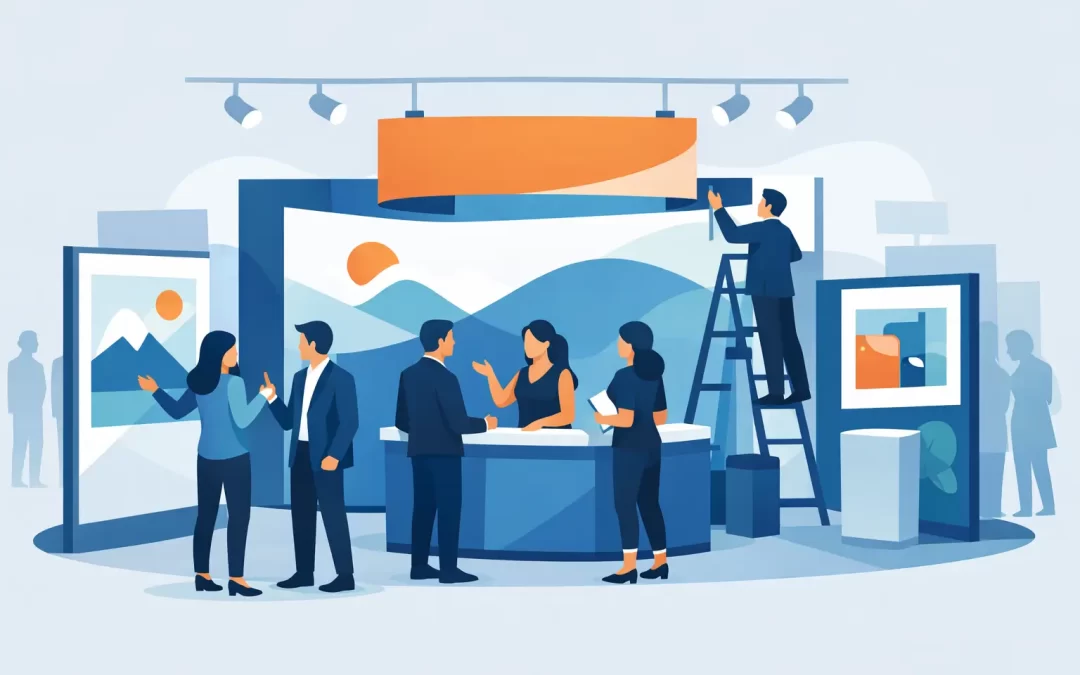
A trade show floor gives visitors seconds to decide whether your booth is worth a stop. Your graphics need to communicate who you are, what you offer, and why it matters before a salesperson says hello. This trade show graphics guide breaks down how to plan display materials that look polished, travel well, and put your brand to work.
Start With the Booth Goal, Not the Banner Size
The most effective trade show graphics are built around one job. A real estate team may need to establish credibility and capture leads. A restaurant group may be promoting catering or franchise opportunities. A hospitality business might need to show guests, planners, or vendors exactly what makes its property different.
Before choosing a backdrop, retractable banner, tabletop display, or foam board, define the action you want attendees to take. That could be booking a meeting, scanning a QR code, requesting a quote, entering a giveaway, or simply remembering your name after a busy event.
A booth that tries to explain every service often creates a wall of small type and mixed messages. Lead with one clear promise, then use secondary graphics and handouts to support the conversation. Your booth graphics should earn attention. Your team and printed collateral can handle the details.
Build a Clear Visual Hierarchy
Trade show visitors do not read display graphics the way they read a brochure. They glance from a distance, move closer if interested, and make fast decisions in a crowded room. Design for that behavior.
Your company name or logo should be easy to identify from across the aisle. Beneath it, use a short headline that explains the value you provide. Think in terms of outcomes: premium event catering, luxury property marketing, reliable commercial printing, or custom displays produced fast. A supporting line can add context, but it should not compete with the headline.
Keep contact details lower on the graphic or reserve them for a takeaway piece. A website address, QR code, and phone number are useful, but they are rarely the message that gets someone to stop. Put the strongest visual and clearest benefit at eye level.
Use the right amount of copy
Large displays need fewer words than most businesses expect. If a sentence cannot be read quickly from several feet away, it belongs in a flyer, brochure, presentation folder, or digital follow-up.
As a practical rule, use one main headline, one short supporting message, and one direct call to action. When more information is necessary, organize it in clear sections rather than shrinking the font. Empty space is not wasted space. It gives your message room to land.
Choose images that hold up at scale
A great phone photo can look acceptable on social media and poor on an eight-foot backdrop. Large-format graphics require high-resolution images, properly prepared logos, and colors that reproduce consistently in print.
Use original photography whenever possible, especially for hotels, restaurants, properties, products, and completed projects. Stock photography can work when it supports the message, but generic images often make a booth feel interchangeable. If the image is central to the design, make sure it has enough resolution for its final print size. Enlarging a small file will not create detail that is not there.
Choose Trade Show Graphics That Fit the Space
The right display package depends on the booth footprint, venue rules, setup time, and how often your team will exhibit. A 10-by-10 booth has different needs than a conference tabletop or a large island exhibit.
Retractable banners are a smart choice for businesses that need portable, reusable signage. They set up quickly, fit into carrying cases, and work well at job fairs, hotel meetings, pop-up events, and standard booth spaces. Use one banner for the core brand message or a set of two or three to separate services, products, or audience-specific offers.
Step-and-repeat backdrops and fabric backwalls create a stronger branded environment. They are especially effective for media moments, product launches, hospitality events, sponsorship areas, and booth spaces where photos will be taken. If your team plans to use the backdrop in pictures, avoid placing key text only at the far edges where people may stand in front of it.
Foam boards, acrylic signs, posters, and mounted displays can add structure to a booth without requiring a full custom build. They work well for pricing, schedules, product features, maps, menus, before-and-after visuals, and directional messaging. For a multi-day show, consider the durability needed for repeated handling and venue traffic.
Table throws and tabletop signs should not be an afterthought. A clean branded table gives staff a professional home base and keeps packing materials, samples, and lead forms out of sight. If the table is where demonstrations or conversations happen, make sure its graphics match the larger display rather than introducing a second visual style.
Plan for Distance, Lighting, and Foot Traffic
Trade show design happens in a real physical environment, not on a laptop screen. A graphic can look balanced at 100 percent zoom and become unreadable once it is installed under bright convention-center lighting.
Place the main message high enough to be seen over people standing nearby. Keep smaller details where visitors can read them at close range. Avoid very light text on a busy photo, thin typefaces, and low-contrast color combinations. White type on a dark solid panel is often more readable than white type placed directly over a detailed image.
Think about where people enter the aisle. A freestanding banner positioned perpendicular to traffic can catch attention before visitors reach the booth. A backdrop works best when it provides a strong focal point behind your team. If the space has open sides, plan graphics for more than one viewing angle.
QR codes deserve special attention. They need adequate contrast, a clear quiet area around the code, and a placement that people can scan without blocking the aisle. Test the code from a printed proof or full-size sample, not only from your computer screen. Send visitors to one focused page, offer, menu, appointment form, or downloadable resource instead of a generic homepage.
Keep Your Brand Consistent Across Every Piece
Your booth should feel connected to the materials attendees take home. Use the same logo treatment, colors, typography, photography style, and message across banners, brochures, postcards, folders, business cards, and follow-up signage.
Consistency matters even more when several people or departments are preparing materials. Marketing may handle the backdrop, sales may order business cards, and an event coordinator may need directional signs at the last minute. Without approved files and templates, small changes can create mismatched colors, outdated logos, and conflicting offers.
For corporate teams with recurring events, centralized ordering and approval workflows can protect brand standards while making reorders faster. It is a practical way to keep regional offices, field teams, and event staff using current materials without adding unnecessary vendor management.
Avoid the Print Problems That Cost Time
The fastest way to miss an event deadline is to treat production as the final step. Large-format graphics need time for file review, proofing, printing, finishing, and packing. If your event is in Miami Beach or greater Miami, local production and pickup can be a major advantage when schedules shift. For out-of-state events, allow time for shipping and venue delivery requirements.
Before sending files to print, confirm the finished size, bleed requirements, safe areas, material, hardware, and whether the display is single-sided or double-sided. Supply logos in vector formats when available. Convert or package fonts as required, and review all phone numbers, URLs, dates, booth numbers, and QR codes one more time.
Color expectations also require a realistic approach. Screens display light, while print uses ink, so colors can vary by material and lighting. Brand-sensitive projects benefit from professional file setup and proof review, particularly when a display must match existing brochures, packaging, or retail signage.
Make the Booth Easy to Use on Event Day
A beautiful backdrop does not help if your team cannot set it up quickly or does not know which banner belongs where. Pack each display with labeled hardware, instructions, and a simple booth layout. Include backup items such as tape, clips, extension cords, cleaning wipes, and extra business cards.
Bring printed materials with a purpose. A one-sheet is ideal for a fast overview. A brochure supports a deeper sales conversation. A postcard can promote a time-sensitive offer. A presentation folder gives high-value prospects a professional package to carry home. Match the piece to the stage of the conversation rather than putting every item on the table.
Need help moving from a rough event idea to print-ready displays? Sobe Express can support the design, production, and fast-turnaround pieces that keep your booth looking prepared. Start with one clear message, give it room to be seen, and let every printed piece make the next conversation easier.
Recent Comments